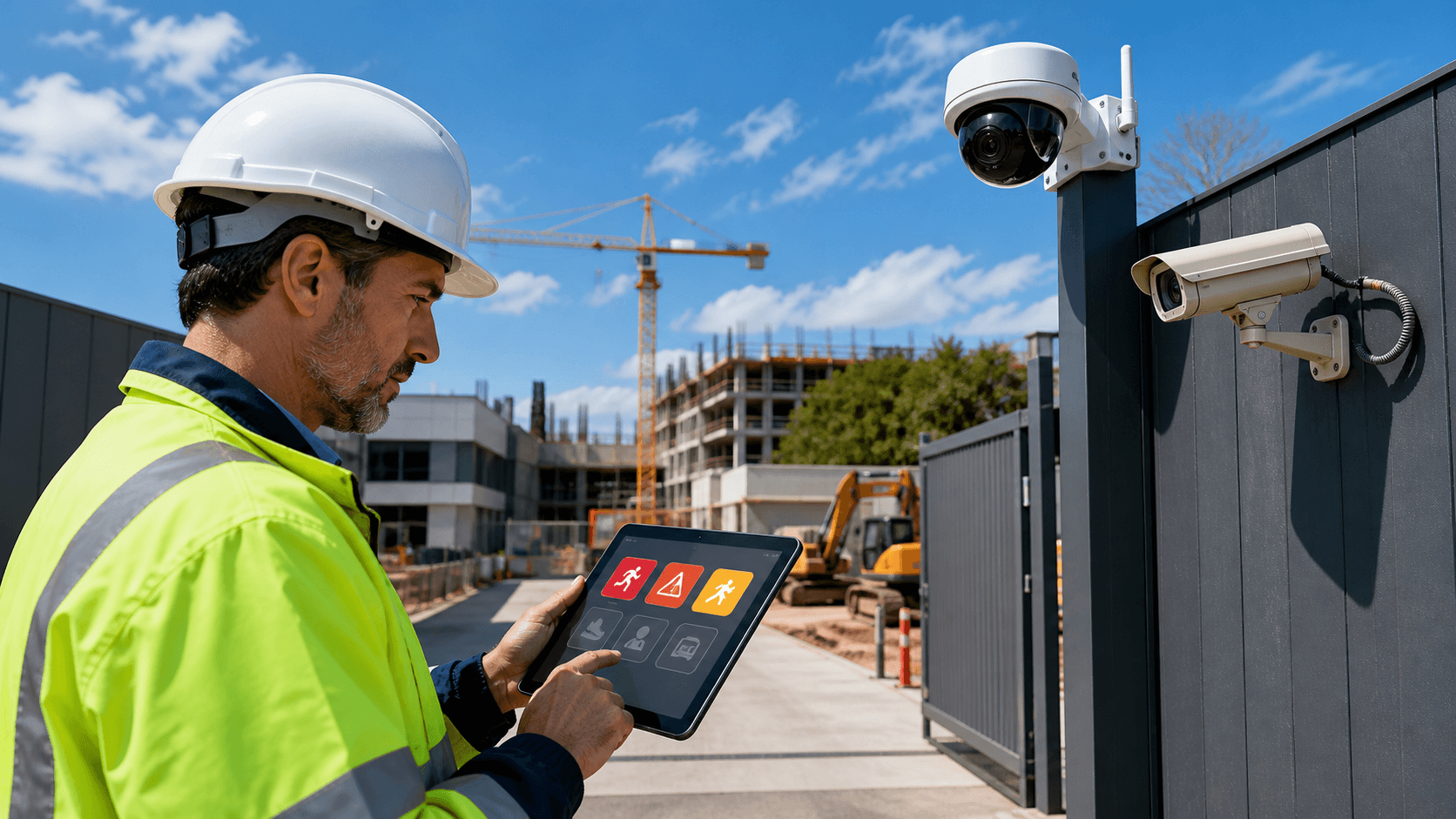
Make Commercial Security Proactive This Spring
Commercial CCTV should do more than record what has already happened. As spring brings longer daylight hours, more construction activity and busier outdoor operations, we help commercial sites across New Zealand think about how they can spot risks earlier and respond with confidence.
Unauthorised access, theft, vandalism and unsafe work practices can all affect a site's day-to-day operation. Clear footage also matters when there are questions about vehicle movements, staff access or activity around valuable equipment. Traditional cameras still serve a purpose, but AI CCTV can give you faster, more useful information when time matters.
Where Traditional Cameras Fall Short on Commercial Sites
Traditional cameras usually record continuously or start recording when movement is detected. That footage can be very helpful after an incident, especially when you need evidence of what happened. The problem is that someone often needs to search through long recordings to find the relevant moment.
For a small, quiet site, that may be manageable. On a warehouse, retail premises, construction site, rural facility or large yard, it can quickly become a slow task. Staff may need to identify a particular vehicle, a person entering an area or an event that happened outside normal operating hours.
Basic motion alerts can add to the workload rather than reduce it. They may be triggered by:
- Rain, shadows or changing light
- Moving trees, grass or loose materials
- Wildlife around a property
- Regular vehicle activity
- Staff moving through approved areas
When alerts arrive too often, it becomes easier to miss the one that matters. We see professional CCTV systems as tools for better site decisions, not simply as a place to store video. Your cameras need to help you find useful evidence quickly and understand what is happening around your premises.
How AI CCTV Delivers Faster Site Intelligence
AI CCTV uses built-in video analytics to tell the difference between selected types of activity. Instead of treating every movement the same way, an AI camera can be set up to recognise people, vehicles and other defined events. That means your notifications can be more relevant to the risks you actually want to manage.
Milesight AI cameras can support commercial sites with features such as person and vehicle classification, intrusion detection and line-crossing alerts. Depending on the area being monitored, we can also consider people counting, licence plate recognition and PPE detection.
These functions can be useful in different parts of a site:
- A perimeter alert when a person enters after hours
- A line-crossing alert at a restricted vehicle entrance
- Licence plate recognition at a controlled driveway
- People counting at defined entry and exit points
- PPE detection in areas where safety compliance is monitored
Rather than searching through a full day of footage, your team can review the event linked to an alert. From there, they can decide whether the activity is expected, whether someone needs to investigate, or whether footage should be kept for later review. AI does not replace good security planning, but it can make the information from your cameras much easier to act on.
Design Professional CCTV Systems Around Real Risks
A camera specification alone does not guarantee useful protection. Effective professional CCTV systems are designed around how your site operates, where people and vehicles enter, what assets need protection, when activity occurs and how reliable your network connection is.
Before selecting cameras, we look at practical details that can shape the outcome. Poor placement can create blind spots, while the wrong angle can make an image difficult to use when you need it most. Lighting also changes throughout the day, particularly in outdoor yards, loading areas and rural locations.
A well-planned system should consider:
- Coverage of gates, entrances and vehicle routes
- Camera placement around high-value stock and equipment
- Image quality and night-time visibility
- Secure recording and appropriate footage retention
- Reliable remote access for authorised managers
Licence plate recognition needs particularly careful planning. The camera must be positioned at a suitable height and angle, with enough lighting and a clear view of approaching vehicles. In the same way, PPE detection can support site awareness, but it should sit alongside workplace safety procedures and supervision rather than replace them.
At Remote Networks, we design and install CCTV around the practical conditions of your premises, rather than expecting one camera type or alert setting to suit every area.
Connect Detection to Faster Incident Response
An AI alert is most useful when it forms part of a clear response plan. We can help you define which events should create a notification and who should receive it. For example, a site manager may need an alert when a vehicle enters a restricted zone, while a security provider may need to know if someone crosses a perimeter after hours.
Once an alert is received, the relevant person can view the event, check whether it needs action and keep the footage that matters. This can reduce uncertainty during an incident and help avoid wasted time reviewing unrelated recordings.
Professional CCTV systems can also work alongside other connected-site tools. Depending on your operation, we may combine cameras with access control, alarms, commercial WiFi and radio communications to improve visibility across difficult-to-reach or dispersed locations.
For commercial, industrial and rural properties, security is often only one part of the wider picture. Our environmental monitoring work can also support awareness around weather conditions, water levels, equipment areas and other operational risks, giving you a clearer view of what is happening across the site.
Plan a Smarter Security Upgrade Today
AI CCTV does not mean every traditional camera needs to be replaced immediately. A sensible upgrade starts by identifying the areas where quicker detection and easier footage searches will make the biggest difference.
We recommend reviewing repeated false alarms, poor night-time images, blind spots, slow searches for footage and uncertainty around pedestrian or vehicle activity. From there, you can prioritise the entrances, yards, assets and restricted areas that need more useful monitoring.
The right approach is one that gives you clear evidence when you need it, relevant alerts when something changes and a practical way to respond before a small issue becomes a larger one.
Strengthen Your Site Security With Smarter Monitoring
Remote Networks can help you select professional CCTV systems that suit your site, operational risks and monitoring requirements. Our team can incorporate AI capabilities such as PPE detection and licence plate recognition where they add practical value. Contact us to discuss a CCTV solution built around your commercial security needs.